Showing posts with label white. Show all posts
Tuesday, May 25, 2010
Poor-man's-pepper
Poor-man's-pepper. The little white flowers are not much to speak of, but the seeds in the flat, round seedpods are edible and do, in fact, taste spicy like pepper.
Growing behind a chain-link fence in an empty lot in Harlem.
Monday, May 24, 2010
Foxglove beardtongue
Foxglove beardtongue. This white relative of hairy beardtongue and fellow member of the snapdragon family has three equal petals below, and two differently-shaped petals on top. Its lance-shaped leaves grow opposite from one another up the stalk.
Technically I'm not certain it is "foxglove" beardtongue - there are several white beardtongues in our area, but they are so close to one another that they can only be distinguished on extremely technical characteristics.
Growing on the west side of the Lake, Central Park.
Friday, May 21, 2010
Daisy fleabane
Daisy fleabane, a white flower. Its pink relative is common fleabane. (The pink puffballs in the background of this picture are red clover.)
Growing in an empty lot in Harlem.
Hedge bindweed
Such an ugly name for such a large, pretty flower. This is the vine hedge bindweed - obviously a relative of the morning glory. Both flowers can have this white and pink color: you can tell it is a hedge bindweed because of its arrowhead-shaped leaves, whereas morning glories have heart-shaped leaves.
arrowhead-shaped leaves
Growing in a bush set back from the west side of the staircase up to the 116th street exit on the west side of Morningside Park, Manhattan.
Japanese honeysuckle
Japanese honeysuckle, a climbing vine. These flowers are unmistakeable with their long, curved stamens and their pretty fluted shape. They can be buttery-yellow to white, depending on their age. Honeysuckle is invasive and hard to eradicate, (it is even completely banned in New Hampshire despite being used as a garden plant elsewhere,) but I'm still fond of it because it attracts so many butterflies and hummingbirds, and has a pleasant sweet smell.
this little black bug liked the flowers too
Growing on the shrubs on the east side of the highest, westmost path around 117th street in Morningside Park, Manhattan.
Garlic mustard
Garlic mustard. I find it hilarious that I didn't recognize this plant at first, because I have bought it from the greenmarket so many times. At first all I saw were the funny upright skeletal-looking seedpods, which did not look familiar.
The jagged, triangular-shaped leaves at bottom right belong to the garlic mustard plant. They are the tasty part: they can be cooked like cultivated mustard greens, of which they are indeed a relative, and they have an additional aroma of garlic - thus the name. The flowers are cross-shaped and white. Sadly, garlic mustard is invasive in many states. It releases chemicals from its roots which inhibit the growth of nearby native species, and it rapidly colonizes new areas because it can self-pollinate (it's advantageous for a plant to clone itself if it's in an area it is already well-adapted to).
Growing in the bushes alongside the central path around 116th street in Morningside Park, Manhattan.
Common mallow
Common mallow. These plants have cute dark leaves shaped like lily-pads and they like to grow right up on the border of sidewalks, on land that has been disturbed. They are relatives of the European "marsh mallow" plant which - yes - was originally used to make real marshmallows. You can use this plant to make them too, apparently, by boiling the leaves or seed pods in water until it is thick, mixing in sugar, then whipping the mixture up until it has a foamy texture and allowing spoonfuls of it to dry. The leaves and wheel-shaped seedpods are also edible on their own. Okra is in the mallow family, so it's unsurprising that both that vegetable and this plant have a mucilaginous texture when cooked.
The flowers can be white, or light pink-purple, or streaked with both colors, like this one.
Growing alongside the lower-level, east side path at about 122nd street in Morningside Park, Manhattan.
Poison hemlock
If you see a plant that looks vaguely like this, DON'T TOUCH IT. We are pretty sure this is the super-toxic poison hemlock. It has many relatives that look similar, some of which are not poisonous, but they're very hard to distinguish from one another, and it is not worth taking any chances. Ingestion of a very small quantity of any part of this plant can cause paralysis which ascends from your feet up to your head and can easily cause death by suffocation. There is no antidote for the poison - the only way to save someone poisoned by hemlock is to put them on artificial ventilation for a couple days until the paralysis wears off.
Terrifying, right?? And it looks so innocent!
You can tell this is poison hemlock, and not its nontoxic relative Queen Anne's lace, because of the way you can see each cluster of flowers come up from a seprate little stalk. The clouds of flowers on Queen Anne's lace look flatter and not like a bunch of separate little flower spheres. The leaves are huge and feathery like a fern, and overall triangular-shaped. It is an imposingly large plant: this one was about as tall as me, and they can grow up to eight feet tall!
Found growing directly next to the stairway around 120th street up to the higher west-side path in Morningside Park, Manhattan.
Rough bedstraw
This mysterious-looking shadowy plant is rough bedstraw. Its leaves grow radially at regular intervals along the branch, and in rough bedstraw each bunch has more or less six leaves in it - this plant has relatives which look very similar, but have fewer or more leaves per bunch. It also has a relative called fragrant bedstraw which is quite similar but doesn't have a hairy/prickly texture. This guy prickled the strap on my camera so I am pretty sure it's the rough variety.
you can kinda see the prickles
The tiny white four-petaled flowers are currently giving way to a multitude of small spherical burrs.
Growing in a large mat on the higher, west-side path at about 120th street in Morningside Park, Manhattan.
Wednesday, May 19, 2010
Shepherd's purse
Shepherd's purse: it has tiny little white flowers which are barely noticeable. The heart-shaped seed pods are the more prominent part, and at the base of the plant is a little rosette of toothed leaves. Those leaves are apparently edible.
Growing by the sidewalk in an empty lot in Harlem.
Canada violet
Canada violet - a white type of violet, with just a few purple streaks on the bottom petal.
Deep in the woods of the Ramble, Central Park.
Foamflower
Foamflower. Lots of wildflower names are appropriate, but this one seems especially so. Up close, it looks more like a weird undersea creature than a flower.
From further away, it looks more like its namesake:
Growing near the north entrance to the Ramble, Central Park.
Forking catchfly
We are pretty sure this is a forking catchfly, though not completely sure. The split petals make it very distinctive.
Northwest side of the Reservoir, Central Park.
Star-of-bethlehem
Star-of-bethlehem. The picture is a little deceptive, because those heart-shaped leaves don't belong to this flower - star-of-bethlehem has long, skinny leaves which are hidden beneath the foliage.
North side of the Reservoir, Central Park.
Hairy beardtongue
Hairy beardtongue - it's easy to see that these guys are relatives of snapdragons. They have little white open mouths.
North side of the Reservoir, Central Park.
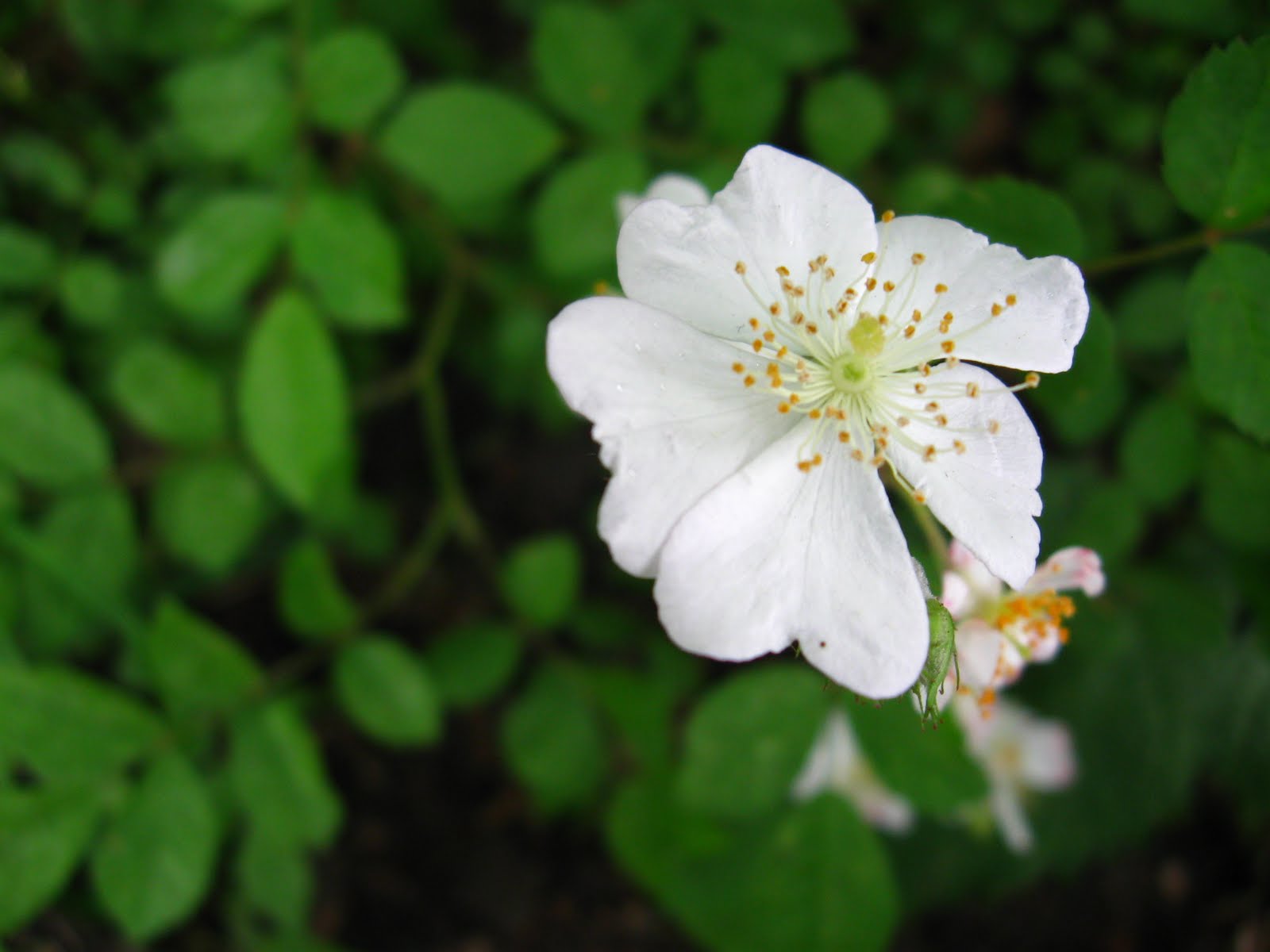
Wild rose
Wild rose, a white variety. (These guys aren't really wild - they are escapes.)
Growing along the path in the North Woods, Central Park.
Subscribe to:
Posts (Atom)